Rain Shadow Desert
Task 1Question
The diagram below shows how one type of desert, known as a rain-shadow desert, is formed.
Summarise the information by selecting and reporting the main features, and make comparisons where
relevant.
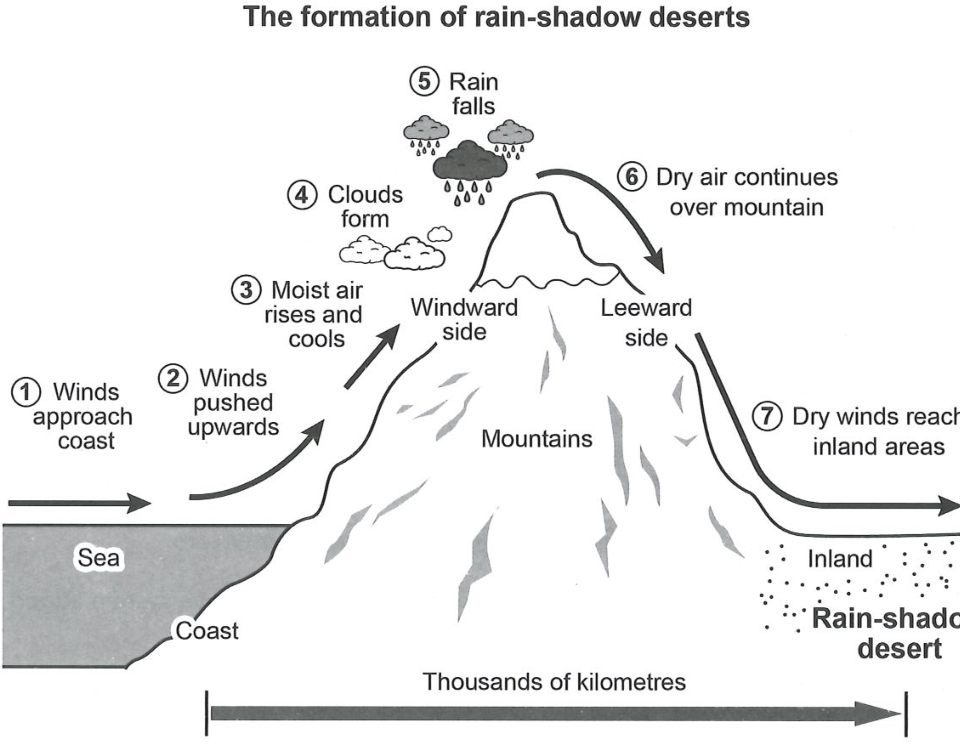
The diagram is a cross-section illustrating the sequence of steps by which a rain-shadow desert
forms inland, next to a coastal mountain range.
The process begins at the sea, where moist winds approach the coast (step 1). As these winds reach
the mountains, they are pushed upwards (step 2), and as they rise they cool down. This causes the
moisture in the air to condense, forming clouds (step 4), which then release rain on the windward
side of the mountains (step 5). This is why the windward side, facing the sea, is wet and supports
plant life.
Once the air has released most of its water, it is now dry and continues to move over the mountain
ridge (step 6). The dry air then descends on the leeward side, the side facing away from the sea,
and reaches the inland areas as dry winds (step 7). Because this air is dry, it produces very little
rain, and over time this creates a rain-shadow desert on the inland side of the mountain range.
Overall, the diagram shows that the same mountain range produces very different conditions on its two
sides: the windward side receives heavy rainfall, while the leeward side, left in the "shadow" of the
mountains, becomes a desert.
Analysis
Task Response
The process is described in the correct sequence, following the path of the air from the sea to the
inland desert. Every numbered step is covered, and the key contrast between the two sides of the
mountain is made explicit.
Takeaway: For a process diagram, follow the numbered steps or arrows carefully and end by stating
the outcome of the whole process.
Coherence & Cohesion
Organised chronologically and then by area (windward vs. leeward). Clear sequence linkers ("The
process begins", "As these winds reach", "Once the air has released", "Overall") guide the reader.
Takeaway: Use first/then/once/finally to match the order of the arrows, and a closing sentence on
the overall result.
Lexical Resource
Logical and precise terminology: "cross-section", "moist winds", "condense", "windward", "leeward",
"desert", "rain-shadow". Technical words are used accurately and appropriately.
Takeaway: Learn directional and weather vocabulary (*windward, leeward, condense, evaporate, moist
air*) for geophysical processes.
Grammatical Range & Accuracy
Sequence is handled with accurate passives and present tense ("are pushed upwards", "the moisture
condenses"). Complex conditional and relative structures are error-free.
Takeaway: Present tense + passive is standard for process diagrams; use "once X has happened" to
chain the steps.