Ethanol Biofuel
Task 1Question
The diagram below shows how a biofuel called ethanol is produced.
Summarise the information by selecting and reporting the main features, and make comparisons where
relevant.
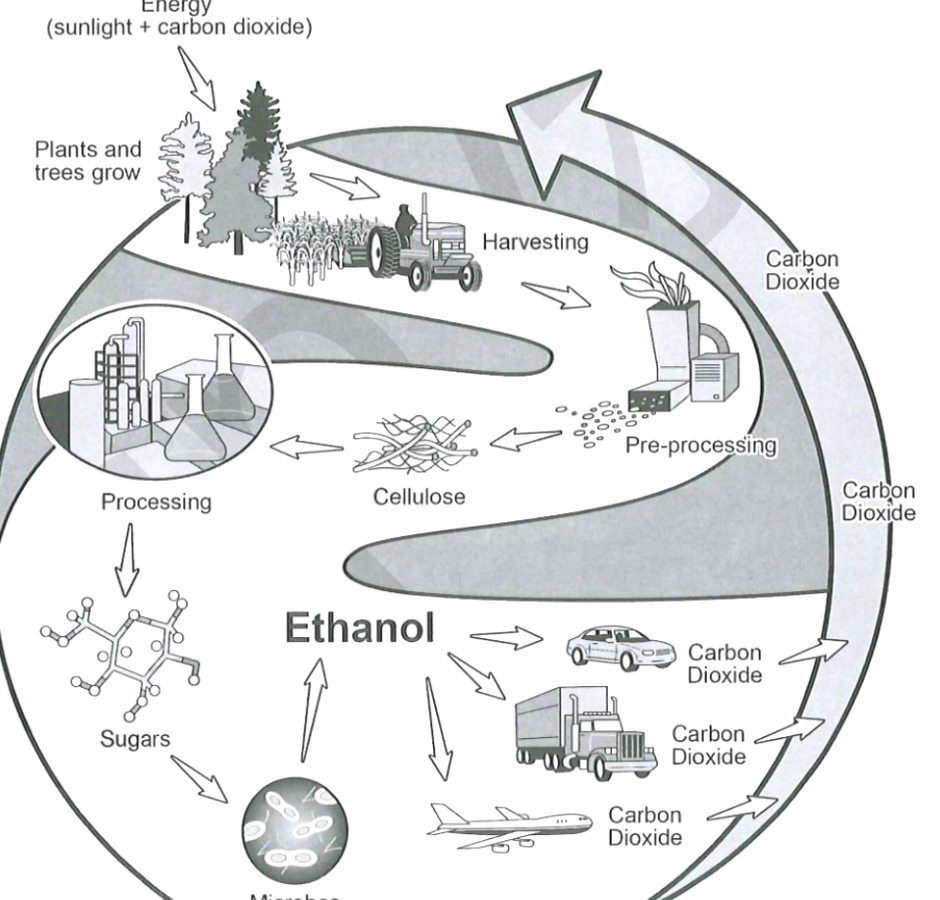
The diagram illustrates the cyclical process by which a biofuel called ethanol is produced, from the
growth of plants to the use of the fuel and the recycling of the by-products back into the process.
The cycle begins with the growing of plants and trees, which absorb energy from sunlight and carbon
dioxide from the atmosphere. Once the crops have matured, they are harvested and transported to a
factory, where they undergo pre-processing to break them down into cellulose. This cellulose is then
passed to the processing stage, where microbes are added to break it down further into sugars. These
sugars are subsequently converted into ethanol, which is the final fuel product.
The ethanol is then distributed and used as a fuel for vehicles such as cars, trucks and aeroplanes.
When the fuel is burned, it releases carbon dioxide into the atmosphere. This carbon dioxide is not
simply a waste product, however; it is re-absorbed by the next generation of plants and trees, which
allows the cycle to begin again. In this way, the process is a relatively closed and sustainable loop,
as the carbon released by burning the fuel is the same carbon originally captured by the plants.
Overall, the production of ethanol is a cyclic process that converts plant material into a usable
fuel, with the carbon dioxide emitted at the end being captured again at the start, making it a
self-sustaining system.
Analysis
Task Response
The process is described in the correct sequential order, and the cyclical nature of the diagram is
clearly emphasised. Every stage — growth, harvesting, pre-processing, processing, sugar conversion and
fuel use — is covered.
Takeaway: For a process diagram, follow the arrows in order and, if the process is cyclical, make
that explicit — the "loop" is the key feature.
Coherence & Cohesion
Organised chronologically, following the flow of the diagram. Clear linking words ("The cycle begins",
"This cellulose is then", "The ethanol is then", "In this way") signal the sequence.
Takeaway: Use sequence linkers (first, then, subsequently, finally, in this way) that match the
direction of the flow.
Lexical Resource
Technical but accessible vocabulary: "cyclical process", "absorb", "matured", "undergo
pre-processing", "cellulose", "microbes", "converted", "self-sustaining". Register is appropriate for
a process description.
Takeaway: Learn process verbs (undergo, convert, process, break down, release, absorb) for any
diagram task.
Grammatical Range & Accuracy
Accurate passive voice throughout ("are broken down", "is then passed", "is subsequently converted"),
which is the correct choice for process diagrams, where the action matters more than who performs it.
Takeaway: Passive voice is the default for describing a process — use it consistently.