Social Centre Participants
Task 1Question
The graph below gives information on the numbers of participants for different activities at one social centre in Melbourne, Australia for the period 2000 to 2020.
Summarise the information by selecting and reporting the main features, and make comparisons where relevant.
Write at least 150 words.
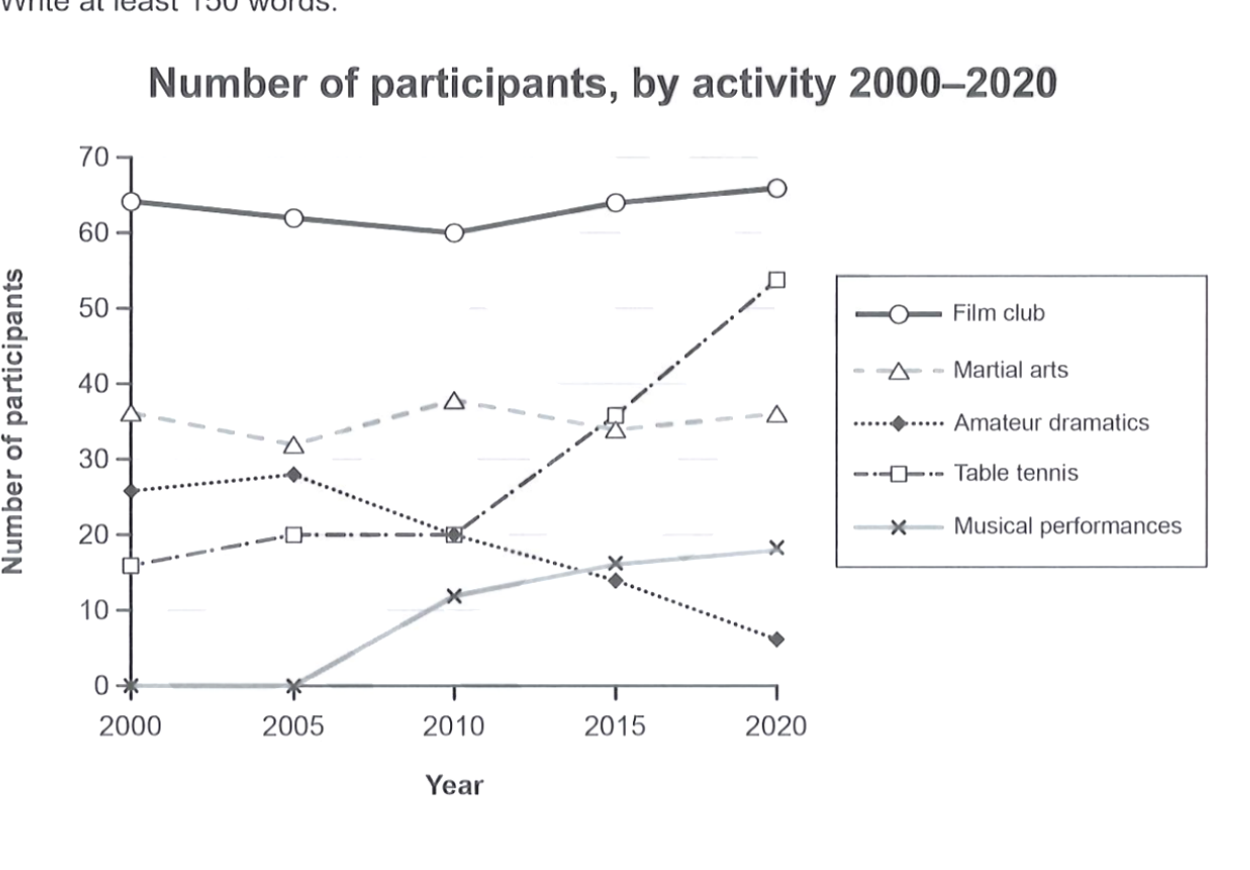
The line graph shows how many people took part in five activities at a social centre in Melbourne between 2000 and 2020.
Overall, the film club remained the most popular activity throughout, while table tennis grew sharply to become the second most popular, and amateur dramatics declined steadily to the lowest level. Musical performances, which started from nothing, rose steadily.
The film club consistently attracted around 60–65 participants, beginning at 65 in 2000 and ending at 65 in 2020, with a slight dip to 60 in 2010. Table tennis started far lower, at about 17 in 2000, and grew steadily to 20 in 2010 before jumping to roughly 34 in 2015 and 54 by 2020, overtaking both martial arts and amateur dramatics.
Martial arts remained fairly stable, fluctuating between about 32 and 39 participants over the period. Amateur dramatics, by contrast, fell continuously from 27 in 2000 to just 8 by 2020, becoming the least popular activity. Musical performances did not exist in 2000 but grew from about 3 in 2005 to roughly 20 by 2020.
Analysis
Task Response
The overview captures the two dominant movements — the film club's stability at the top and table tennis' rapid rise to overtake others — plus the notable fall of amateur dramatics. It flags the five activities without burying the reader in a list.
Takeaway: when one line is stable and high and another surges, make the overtaking the spine of the overview, and mention the biggest fall — those are the three insights that carry a multi-line graph.
Coherence & Cohesion
Paragraphs are paired by role: the dominant/story activity (film + table tennis), then the remaining three grouped. This separates the "headline" lines from the supporting ones, giving the report a clear hierarchy.
Takeaway: put the two most important lines in the first body paragraph and batch the rest in the second, so the reader gets the key comparison before the supporting detail.
Lexical Resource
Movement verbs are varied and precise: "remained", "grew sharply", "declined steadily", "fluctuating", "jumping", "fell continuously." "The most popular activity" and "the least popular" anchor the ranking.
Takeaway: build a movement-verb range (remain, fluctuate, surge, jump, fall continuously, decline) and pair each with an adverb of pace (sharply, steadily, continuously) to make the trends precise.
Grammatical Range & Accuracy
The essay uses comparatives and clarity phrases: "starting at 65 in 2000 and ending at 65 in 2020", "with a slight dip to 60 in 2010", "overtaking both martial arts and amateur dramatics" (participle), and "which started from nothing" (non-defining relative).
Takeaway: use a present-participle ("overtaking...") for a ranking change and a non-defining relative ("which started from nothing") to add profile to a line without a new sentence.