Family Spending
Bar ChartQuestion
The chart below gives information about how families in one country spent their weekly income in 1968 and in 2018.
Summarise the information by selecting and reporting the main features, and make comparisons where relevant.
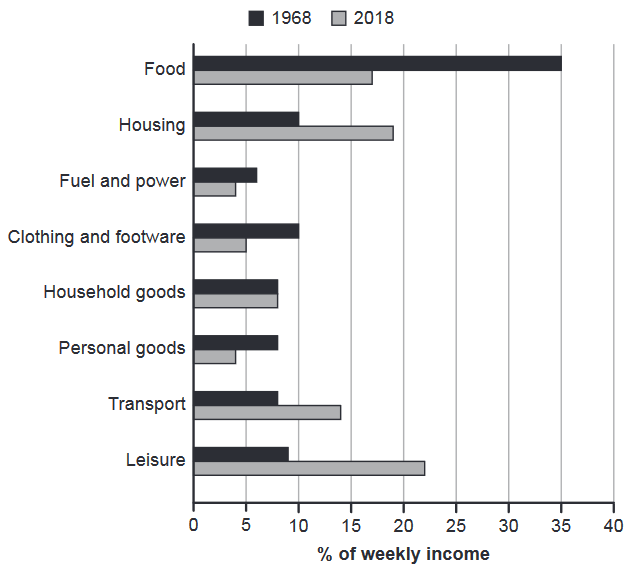
The bar chart compares how families in one country allocated their weekly income across eight categories in 1968 and 2018.
Overall, spending patterns shifted dramatically over fifty years. Food's share fell by more than half, while leisure spending surged to become the largest category. In broad terms, spending on necessities declined and discretionary expenditure rose.
In 1968, food dominated at 35% of weekly income — more than three times any other category. Housing and clothing each accounted for 10%, while transport, household goods, personal goods, and leisure all clustered between 8% and 9%. Fuel and power received the smallest allocation at 6%.
By 2018, the picture had been transformed. Food collapsed to 17%, losing its dominance. Leisure more than doubled to 22%, becoming the largest category. Housing nearly doubled to 19%, and transport rose to 14%. Several categories contracted: clothing and footwear halved to 5%, personal goods dropped to 4%, and fuel and power edged down to 4%. Household goods remained unchanged at 8%.
The data suggests a transition from a budget dominated by necessities — food alone took over a third of income in 1968 — to one where discretionary spending on leisure and housing commanded the largest shares.
Analysis
Task Response
The essay satisfies all Band 8+ Task 1 criteria: it presents a clear overview, covers all eight categories with selective emphasis, embeds comparisons throughout, and closes with an interpretive summary that goes beyond the overview.
1. Overview as a standalone paragraph: The overview occupies its own paragraph immediately after the paraphrase: "Overall, spending patterns shifted dramatically over fifty years. Food's share fell by more than half, while leisure spending surged to become the largest category." It identifies the two most significant changes (food's collapse, leisure's rise) and a generalisation ("spending on necessities declined and discretionary expenditure rose"). This is a Band 8+ requirement — the overview is not buried in the introduction or tacked onto the conclusion.
2. Selective emphasis on story protagonists: All eight categories appear, but space is allocated proportionally to significance. Food (35% → 17%, the largest absolute change) and leisure (9% → 22%, the new leader) receive the most attention and multi-sentence treatment. Minor changes — fuel and power (6% → 4%) and household goods (unchanged at 8%) — are dispatched concisely. This avoids the 7.0 tendency to give every data point equal weight regardless of importance.
3. Comparisons embedded in narrative, not listed: Instead of a mechanical "X was higher than Y," comparisons are woven into the descriptive flow. "Food dominated at 35% of weekly income — more than three times any other category" directly compares food to every other category in a single clause. "Transport, household goods, personal goods, and leisure all clustered between 8% and 9%" groups similar values into one efficient statement rather than listing four separate data points.
4. Interpretive conclusion beyond the overview: The final sentence — "The data suggests a transition from a budget dominated by necessities — food alone took over a third of income in 1968 — to one where discretionary spending on leisure and housing commanded the largest shares" — introduces a conceptual layer (necessities vs. discretionary spending) that the overview did not state. This adds analytical value without redundancy.
Reusable technique: In Task 1, sort your data into "story protagonists" (the largest changes — spend 2-3 sentences on each) and "supporting cast" (minor changes — spend 1 sentence or less). The examiner rewards selection, not exhaustive description.
Coherence & Cohesion
1. "Overall" as the overview signpost: The single word anchors the entire overview paragraph and signals unambiguously to the examiner that what follows identifies main features, not details. It is followed by two specific trends (food fell, leisure surged) and one generalisation ("In broad terms, spending on necessities declined and discretionary expenditure rose"), creating a neat funnel from specific to general.
2. Time-jump transition via past perfect passive: "By 2018, the picture had been transformed." — Rather than a mechanical "Turning to 2018" or "In 2018, however," this sentence uses the past perfect passive to signal both a temporal shift and the magnitude of the change. "Transformed" previews that what follows is substantively different, not merely numerically adjusted. The sentence earns its weight.
3. Colon-bundled parallel listing for minor changes: "Several categories contracted: clothing and footwear halved to 5%, personal goods dropped to 4%, and fuel and power edged down to 4%." — The colon introduces a list, and the parallel structure (subject + verb + to Y) makes three data points readable as one unit. The verb choices (halved, dropped, edged down) differentiate magnitude within the parallel frame.
4. Exception as a structural close: "Household goods remained unchanged at 8%." — After a paragraph of dramatic transformations, the exception provides a satisfying structural close. It also demonstrates the writer's awareness of all data points, including the one that did not change.
5. Dash-delimited interpretive summary with data anchor: "a transition from a budget dominated by necessities — food alone took over a third of income in 1968 — to one where discretionary spending on leisure and housing commanded the largest shares" — The dash insertion provides a concrete data anchor (food at 35%) inside an abstract framing, grounding the interpretation in evidence rather than floating it as pure assertion.
Reusable technique: Close a Task 1 data paragraph with the exception or anomaly — it shows thoroughness and creates a natural punctuation point before moving on. Use a colon to bundle minor changes into one efficient sentence rather than writing three separate ones.
Lexical Resource
1. "collapsed to 17%" + "losing its dominance" — "Collapsed" conveys both direction and magnitude in one word, far more efficient than "decreased dramatically." Paired with "losing its dominance," the vocabulary choice creates a coherent image: food did not merely decline numerically; it lost power. The personification is a Band 8+ feature.
2. "more than doubled" / "nearly doubled" — differentiated precision: The distinction between "more than" (exceeding 2×: leisure 9% → 22%) and "nearly" (approaching 2×: housing 10% → 19%) shows lexical calibration. The 7.0 writer reaches for "increased significantly" for both; the 8.5 writer differentiates.
3. Graded verb hierarchy for decrease: "collapsed" (35% → 17%, dramatic), "halved" (10% → 5%, proportional), "dropped" (8% → 4%, moderate), "edged down" (6% → 4%, marginal). Four different decrease verbs, each calibrated to the actual magnitude of change. None are interchangeable — substituting "collapsed" for the 2pp fuel-and-power change would be inaccurate, and "edged down" for food's 18pp drop would be understatement.
4. "discretionary spending" vs. "necessities" — These are category-level abstractions that synthesise eight specific items into two conceptual groupings. "Discretionary" is a high-register economics term used accurately and without pretension. The writer demonstrates the ability to move between concrete data and abstract classification.
5. "commanded the largest shares" / "clustered between 8% and 9%" — "Commanded" implies dominance and authority, not merely size. It is a collocation native speakers use for market-share language and elevates the prose above the mechanical "were the largest." Similarly, "clustered between 8% and 9%" uses "clustered" as a precise range term that implies natural grouping.
Reusable technique: Build a verb gradient for Task 1 and calibrate it to the actual data magnitude. For increases: surged > rose > edged up. For decreases: collapsed > halved > dropped > edged down. Examiners notice when a 2% change is described as "dramatic" or a 50% drop as "a slight decline."
Grammatical Range & Accuracy
1. Past perfect passive for transformation: "By 2018, the picture had been transformed." — The sentence packs three grammatical features: a past time marker ("By 2018"), the past perfect aspect ("had been"), and the passive voice ("been transformed"). It efficiently signals that 2018 is the endpoint of a process that began in 1968, and the passive foregrounds the transformation itself rather than an agent.
2. Dash-delimited comparative insertion: "Food dominated at 35% of weekly income — more than three times any other category" — The dash inserts a striking multiplicative comparison that would be grammatically awkward to integrate directly into the main clause. The structure "more than X times any other Y" is concise, high-register, and native-like.
3. Participial phrases for economy and fluidity: "losing its dominance", "becoming the largest category" — Two participial constructions attach consequences to main clauses without fragmenting sentences. Compare: "Food collapsed to 17%. It lost its dominance." (two choppy sentences) vs. "Food collapsed to 17%, losing its dominance." (one fluid sentence). The technique compresses information dense paragraphs into tight, readable prose.
4. Colon introducing a grammatically complete parallel list: "several categories contracted: clothing and footwear halved to 5%, personal goods dropped to 4%, and fuel and power edged down to 4%." — The colon sets up a fully grammatical list of independent clauses in parallel structure (subject + verb + to Y). The rhythm carries the reader through three data points without fatigue.
5. Multiplicative comparative structure: "more than three times any other category" — This construction avoids the clunkiness of "35% was more than 3 times larger than the next highest category, which was 10%." The pattern "more than X times any other Y" is concise and native-like.
Reusable technique: For Task 1, use participial phrases (verb + -ing) after commas to attach consequences without fragmenting sentences. Example: "Leisure more than doubled to 22%, becoming the largest category." One sentence delivers multiple pieces of information that a 7.0 writer would spread across two or three.